Build a Help Desk That Solves on First Contact


Most support inefficiency doesn’t come from slow agents - it comes from how tickets move between teams.
A customer emails about a billing charge that doesn't match their invoice. Your help desk routes it to support. Support reads it, decides it's a finance question, and reassigns it. Finance opens it three hours later, replies that the customer needs to verify their plan tier with sales, and bounces it again. By the time someone finally answers, the customer has reopened the ticket twice and left a one-star review.
This pattern is the single biggest drag on customer support efficiency in mid-size companies, and it has almost nothing to do with the people working the queue. The difference sits in how the help desk is designed behind the scenes.
A help desk with first-contact resolution is a support setup where the first agent to receive a ticket has the context, permissions, and routing logic to resolve it without handing it to another team. First-contact resolution (also called first-call resolution or FCR) applies to support teams handling repeatable issues across multiple channels, and the outcome is shorter time-to-resolution, fewer reopened tickets, and a measurable lift in customer satisfaction. It works best when ticket volume is high enough that bounce rate becomes visible in the data, but small enough that you can still redesign your routing rules without a six-month project.
Most teams treat ticket bouncing as a people problem - more training, better notes, stricter handoff rules. That fixes nothing. Bouncing is a system problem, and a help desk built for first-contact resolution treats it that way. The four rules below are the ones that actually move the needle, drawn from how high-performing support orgs structure their queues, their SLAs, and their tooling.

Why Tickets Keep Bouncing Between Teams
Ticket bounce - the repeated transfer of a ticket between agents or departments before resolution - happens for predictable reasons. Diagnosing them is the first step toward building a help desk that closes issues on first contact.
The most common cause is routing by category instead of by skill. A help desk that sends every billing question to finance assumes finance can handle all of them. Most can’t. They can deal with accounting issues; the actual customer problem is usually a product issue dressed up as billing. Routing should match the agent’s real skill set, not the surface label of the ticket.
The second cause is missing context on handoff. When agent A passes a ticket to agent B with two lines of notes, agent B has to start the conversation over. The customer repeats themselves, gets frustrated, and the ticket bounces back when agent B realizes they're missing the original screenshot. A help desk with first-contact resolution treats context as the asset that travels with the ticket - full conversation history, customer record, prior tickets, account tier, and any internal flags the agent already added.
A third cause is fuzzy ownership. If a ticket has three watchers and no clear owner, no one is accountable. Watchers chime in with opinions, the ticket drifts, and the customer waits. One owner, one set of permissions, one deadline.
Finally, there's escalation theater. Agents bounce tickets up the chain not because the issue is genuinely above their level, but because they're not allowed to make the call. If your agents can't issue a refund under $50 without approval, expect them to escalate every refund ticket. Permissions are routing rules in disguise.

Four Rules for First-Contact Resolution
The four rules below are stackable. You don't have to roll them out all at once, but a help desk that ignores any of them will keep bouncing tickets no matter how many dashboards you bolt on.
1. Route by Skill and Channel, Not by Department
Skill-based routing assigns tickets to agents based on what they can actually solve, not which org chart box they sit in. Channel routing layers on top: a chat ticket from a paying customer at 2pm should land with a different agent than an email from a free user at midnight. The point is to put the ticket in front of someone who can close it on first read.
The simplest version of this works with three signals: topic (what is the ticket about), channel (how did it arrive), and customer tier (who is asking). A help desk that combines these three into a routing rule will close more tickets on first contact than one that uses any single signal alone. Tools like the Bitrix24 Contact Center consolidate channels - email, web forms, live chat, social, phone - into one queue, so the routing layer has full visibility instead of guessing across silos.
A useful exercise: pull your last 200 bounced tickets and ask, for each one, which signal would have routed it correctly the first time. If the answer is "skill," your topic taxonomy needs work. If it's "channel," you're losing context at the channel boundary. If it's "tier," your CRM and your help desk aren't talking.
2. Set a Clear SLA for Each Ticket Stage
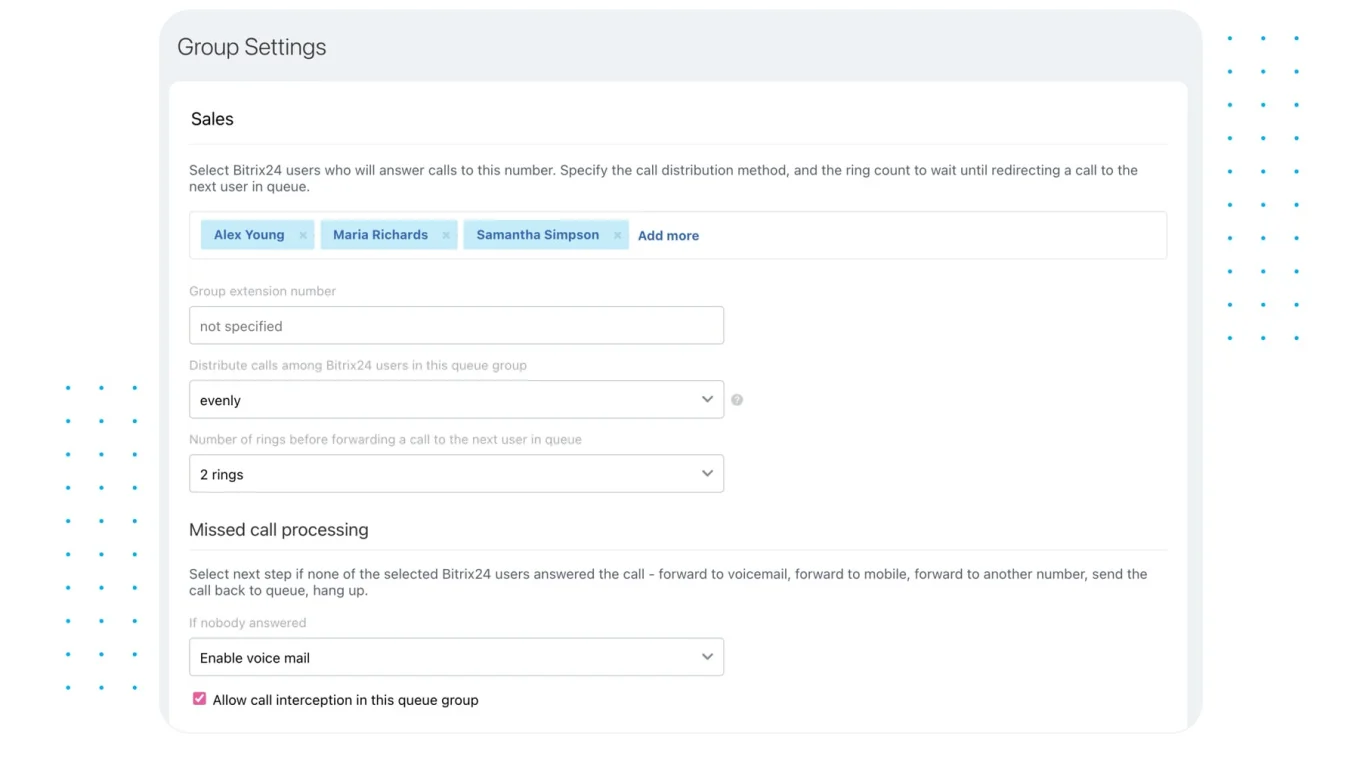
A service-level agreement (SLA) defines how long each stage of a ticket can take before action is required. Most help desks have a single SLA - "respond within 4 hours" - and that's it. That's not enough. SLA management in support means setting separate clocks for first response, ownership confirmation, internal handoff (if any), and final resolution.
Stage-level SLAs do two things. First, they make ticket bounce visible: if a ticket has been transferred twice and the resolution clock is still running, the dashboard lights up. Second, they give agents permission to escalate based on time, not feeling. An agent who has owned a ticket for six hours past the resolution SLA shouldn't be sitting on it - the system should have already pinged a manager or auto-reassigned.
The trick is keeping SLAs realistic. A 30-minute first response on chat is reasonable; a 30-minute resolution on a complex API question is not. Build SLAs from your actual historical data, not from what looks good on a slide. Then publish them to the team and review them quarterly.
3. Assign One Owner With Full Context
Every ticket needs exactly one accountable owner from the moment it enters the queue. Watchers and collaborators are fine, but ownership is singular. The owner sees the ticket through to closure, including any handoffs, and is the single point of contact for the customer.
Full context means the owner has, on the ticket screen, everything they need to make a decision: customer history, prior tickets, current plan and billing status, product usage signals, and any related internal threads. A help desk that requires the agent to open three other tabs to find this is bouncing tickets by design. Integration between the help desk and the CRM is non-negotiable here - if your support agent can't see the deal that closed last quarter, they're going to give the wrong answer to your biggest customer.
This is also where customer service CRM integration earns its keep. The CRM holds the relationship; the help desk holds the conversation. Connecting them turns the help desk into a context-rich workspace instead of an inbox with categories.
4. Automate Escalation With Clear Criteria
Escalation should be a rule, not a vibe. The criteria for moving a ticket up - or sideways to another team - have to be written down and triggered automatically wherever possible. "Senior agent reviews tickets older than X hours with sentiment flag Y" is a rule. "Sarah handles the hard ones" is not.
Ticket routing automation handles the mechanics: if a ticket matches certain conditions (overdue, high-value customer, repeat issue, negative sentiment), the system reassigns it or notifies a manager without the agent having to ask. This kills the most common form of escalation theater, which is agents bouncing tickets out of caution. With clear automated criteria, agents know when to escalate and, just as critically, when not to.
The result is fewer transfers, less manager time spent triaging, and tickets that close on first contact because the agent had clear rules about what they could decide on their own.
First-Contact Resolution Toolkit: Scripts, Triage, Escalation Rules
Enter your email address to get a comprehensive, step-by-step guide

Reactive vs. Designed Help Desk Flow: A Comparison
Most help desks operate on a reactive flow - tickets arrive, agents react, transfers happen ad hoc. A help desk built for first-contact resolution runs on designed flow, where routing, ownership, and escalation are defined up front. The difference shows up in every metric that matters.
|
Dimension |
Reactive Flow |
Designed Flow (FCR-Oriented) |
|---|---|---|
|
Routing logic |
By department label |
By skill, channel, and customer tier |
|
Context on handoff |
1-2 lines of notes |
Full ticket history, CRM record, prior issues |
|
Ownership |
Multiple watchers, unclear owner |
Single accountable owner per ticket |
|
SLA structure |
One global SLA |
Stage-level SLAs (response, ownership, resolution) |
|
Escalation trigger |
Agent judgment |
Automated rules + clear criteria |
|
Visibility into bounce |
Anecdotal |
Dashboard metric, tracked per agent |
|
Typical FCR rate |
Hard to measure |
65-80% in mid-size SaaS support teams |
|
Customer experience |
Repeat-the-issue fatigue |
Single conversation, single resolution |
The comparison isn’t subtle. Reactive flow scales linearly with headcount: more tickets mean more agents, and more agents mean more bounces. Designed flow scales with rules: more tickets tighten the rules, and tighter rules reduce bounces.
How to Roll Out First-Contact Resolution With SLAs
Rolling out first-contact resolution rules in a working help desk takes about six to ten weeks if you're disciplined about it. The sequence below is the one that consistently produces results without disrupting the existing queue.
Week 1-2: Audit. Pull the last 60-90 days of tickets. Tag every transfer. Calculate your current first-contact resolution rate, your average number of transfers per ticket, and your top five reasons for bouncing. Don't skip this - if you don't know your baseline, you can't tell whether your changes worked.
Week 3-4: Redesign routing. Build a topic taxonomy that matches actual ticket content, not org structure. Map each topic to a skill, then to an agent or pool of agents. Layer channel and tier on top. Test the routing on a sample of recent tickets before going live.
Week 5-6: Stand up stage-level SLAs. Define separate SLAs for first response, ownership confirmation, and resolution. Use historical data to set targets. Publish them. Build dashboards that surface SLA breaches in real time.
Week 7-8: Tighten ownership and permissions. Audit your permission model. What can agents decide without escalating? Refunds under a threshold? Plan changes? Access requests? Move as much as you reasonably can to the agent level. Then make ownership singular - one ticket, one owner, no exceptions.
Week 9-10: Automate escalation. Build the automation rules: overdue tickets, sentiment flags, repeat issues, and high-value customers. Most help desk platforms and ticket management systems support this with a workflow builder; tools like Bitrix24 Tasks and Projects extend that with cross-team notifications so escalation doesn't get stuck in a single inbox.
After ten weeks, measure again. A well-executed rollout should show a 15-25 percentage point lift in first-contact resolution rate and a meaningful drop in average resolution time. If it doesn't, the audit data will tell you which rule didn't land.

Where First-Contact Resolution Doesn’t Fit
A help desk with first-contact resolution isn't a fit for every support situation. The model assumes a high enough volume of repeatable issues that routing rules pay off. For teams handling fewer than 50 tickets a week, the overhead of designing all this isn't worth it - you're better off with a small queue and a single triage agent.
The model also struggles with genuinely novel issues. If your product is in heavy active development and every other ticket is a new edge case, agents won't have the context to close them on first contact, regardless of how good your routing is. Mature products with stable features benefit most.
A few mistakes show up over and over in rollouts:
- Treating FCR as the only metric. First-contact resolution rate is meaningful, but if agents start gaming it - closing tickets prematurely or pushing customers off the channel - your CSAT will tank. Pair FCR with reopen rate and CSAT.
- Routing by department names. "Send all billing questions to billing" is the laziest possible routing rule. It will produce the most bounces.
- Skipping the audit. Teams that try to redesign routing without baseline data tend to optimize for the wrong tickets. The audit is annoying. Do it anyway.
- Underestimating training. Even perfect routing rules fail if agents don't understand the new permissions or the new SLA structure. Plan two weeks of internal enablement.
- Forgetting the knowledge base. A self-service knowledge base catches the easy tickets before they enter the queue, which lifts FCR on the harder tickets agents actually see. Skipping this means your agents are answering the same five questions all day.
- Treating escalation as failure. Some tickets genuinely need to escalate. The goal is to remove unnecessary escalations, not to penalize agents for the necessary ones.
The honest answer on FCR rate: most mid-size support teams that do this well land between 65% and 80% on first-contact resolution. Anything above 80% usually means agents are closing tickets too aggressively, and anything below 60% suggests the rules haven't been tightened yet. Watch the trend, not the absolute number.

Build a Help Desk That Closes Tickets on First Contact With Bitrix24
Most of what makes a help desk with first-contact resolution work isn’t a single feature - it’s how the contact center, the CRM, automation rules, and internal tasks work together on the same ticket. Bitrix24 connects those layers inside one workspace, so the system behaves as a whole instead of as separate tools.
At the entry point, the Contact Center consolidates email, chat, web forms, social, and phone into a single queue. Routing rules and automation act on every ticket as it arrives, using channel, topic, and customer data without losing context between systems. The CRM record sits next to the ticket, giving the agent full visibility into the customer’s history, plan, and prior interactions at the moment of first response.
From there, execution stays inside the same flow. Automation rules assign owners, trigger escalations, and enforce SLA conditions based on what happens in the ticket, not on manual follow-up. When a case requires input from another team, internal tasks are created and linked directly to the ticket, so finance, engineering, or account management can contribute without taking ownership away from support or breaking the conversation into separate threads.
A built-in knowledge base removes repeatable questions before they reach the queue, which raises first-contact resolution on the issues that actually require an agent. What remains are tickets that arrive with context, land with the right owner, and move forward under clear rules instead of ad hoc decisions.
If your support queue is losing time on transfers, reopens, and fragmented conversations, the fastest way to test whether designed flow improves your numbers is to run it on a real queue. Set up your routing, ownership, and automation inside a single system, and track how your first-contact resolution rate changes over the next quarter. Create your Bitrix24 account today and run it on your own support queue.
Revolutionize Your Help Desk Now
Avoid bouncing around tickets, prolonging resolutions and frustrating customers with Bitrix24. Streamline your helpdesk by enabling first-contact resolutions, improving both efficiency and customer satisfaction.
Get Started NowFAQs
How does Bitrix24 speed up first response in a help desk with first-contact resolution?
Bitrix24 speeds up first response in a help desk with first-contact resolution by consolidating all channels - email, chat, social, web forms, phone - into one queue, so routing rules act on every ticket the moment it arrives. Agents see the full customer record alongside the ticket, which removes the tab-switching that delays first replies. Automation rules trigger acknowledgments and assign owners without manual triage.
Can a help desk with first-contact resolution route tickets by urgency, channel, or topic?
Yes, a help desk with first-contact resolution can route tickets by urgency, channel, and topic, and the strongest setups combine all three. Topic-based routing sends tickets to the agent with the right skill, channel routing accounts for response-time expectations on chat versus email, and urgency or customer tier overrides both when a high-value account is involved.
How is context preserved when a ticket moves across teams in a help desk with first-contact resolution?
Context is preserved when a ticket moves across teams in a help desk with first-contact resolution by keeping the ticket as the single source of truth and linking any cross-team work to it through internal tasks. The original conversation, customer record, and prior history travel with the ticket, so the next person doesn't restart the conversation. Cross-team notifications surface updates to the original owner.
Which KPIs prove that a help desk with first-contact resolution is improving?
The KPIs that prove a help desk with first-contact resolution is improving are the first-contact resolution rate, the average number of transfers per ticket, the reopen rate within seven days, the average time to resolution, and customer satisfaction on resolved tickets. Watching FCR alone is risky - pair it with the reopen rate so agents don't close tickets prematurely.
Which rules actually reduce ticket bounce between teams?
The rules that actually reduce ticket bounce between teams are skill-based routing instead of department-based routing, stage-level SLAs that flag transfers as breaches, single accountable ownership per ticket, and automated escalation criteria that remove agent guesswork. Permission expansion - giving agents authority to resolve common issues without approval - cuts the most preventable transfers.
What is a realistic first-contact resolution rate for a mid-size support team?
A realistic first-contact resolution rate for a mid-size support team is between 65% and 80%, depending on product complexity and ticket mix. Below 60% usually indicates weak routing or missing context during handoff. Above 80% often means agents are closing tickets prematurely, so pair the number with the reopen rate and CSAT to confirm the lift is real.