Traceability by design: 6 ways to connect your roadmaps and sprints seamlessly


Traceability breaks down when sprint work isn’t clearly connected to roadmap goals. Teams complete tasks and improve velocity, but struggle to show how that work actually moves strategic initiatives forward.
That’s why progress often gets reported as activity rather than outcomes. It also explains why teams get stuck when asked a simple question: “are we actually closer to our goals?”
Traceability fixes this by linking every sprint task back to a roadmap initiative through a clear hierarchy.
In the six practices below, you’ll see how to build that connection into your workflows so strategy, execution, and reporting stay aligned as your projects scale.
TL;DR: Traceability means every sprint task links back to a roadmap initiative through a clear hierarchy: initiative → project → sprint → task. Six practices — structured hierarchy, milestone translation, shared workspaces, task dependencies, progress dashboards, and workflow automation — keep strategy and execution connected as work scales.
Why traceability breaks down
McKinsey's agile research found that organizations that get execution right see roughly 30% gains in efficiency, customer satisfaction, employee engagement, and operational performance. But the 17th State of Agile Report paints a less optimistic picture:
- 41% cite company culture as the primary barrier to agile success
- 38% point to insufficient management support
- 25% identify an inability to continuously prioritize work
The common thread: a lack of structural alignment between strategy and execution. Teams aren't careless, as such; the systems they use simply don't maintain the connection between roadmap goals and daily work.
1. Start with a clear hierarchy from initiatives to tasks
Without a clear hierarchy, sprint tasks disconnect from strategy within days.
The four-level structure:
- Initiatives — strategic goals (launch a new feature, improve onboarding, enter a new market)
- Projects/Epics — major deliverables that advance each initiative
- Sprints — time-boxed cycles that break projects into executable chunks
- Tasks — the daily work your team completes
|
Example: An initiative to “improve customer onboarding” breaks into three projects: redesign the onboarding flow, build onboarding automation, and create training resources. The “redesign onboarding flow” project might span multiple sprints:
Within Sprint 2, tasks could include:
Each of these tasks links back to the sprint, the project, and ultimately the onboarding initiative, making it clear how daily work contributes to the strategic goal. |
Why the chain matters:
- Teams prioritize effectively because they see which tasks support the most important initiatives
- Progress is trackable across workstreams, not just within individual sprints
- When someone asks "why are we building this?" the answer is one click away
Without this structure, teams default to working through the backlog in whatever order feels urgent, which is how roadmap priorities quietly lose influence on daily execution.
In Bitrix24, teams organize this using projects and workgroups to represent initiatives, task hierarchies and subtasks for execution, and milestones to track progress. All inside the same platform where sprint work happens. Check out our full range of solutions here.
Roadmap Traceability Workbook: Link Sprints Without Losing Context
Enter your email address to get a comprehensive, step-by-step guide

2. Turn roadmap milestones into sprint deliverables
Roadmaps fail when milestones stay abstract. "Launch a new reporting dashboard in Q3" sounds clear, but unless it's broken into sprint deliverables, no one knows what to build this week.
What strong milestones look like:
- Weak: "Improve analytics" — no way to know when it's done
- Strong: "Release customer analytics dashboard" — the team can define the work and track progress toward a clear finish line
Breaking milestones across sprints:
- Sprint 1: Metrics definition and UI wireframes
- Sprint 2: Backend integration and interface development
- Sprint 3: QA testing and release preparation
The one question that prevents drift: During sprint planning, ask: which roadmap milestone does this sprint support? If a task can't be traced back to an active initiative, it either belongs in the backlog or needs justification.
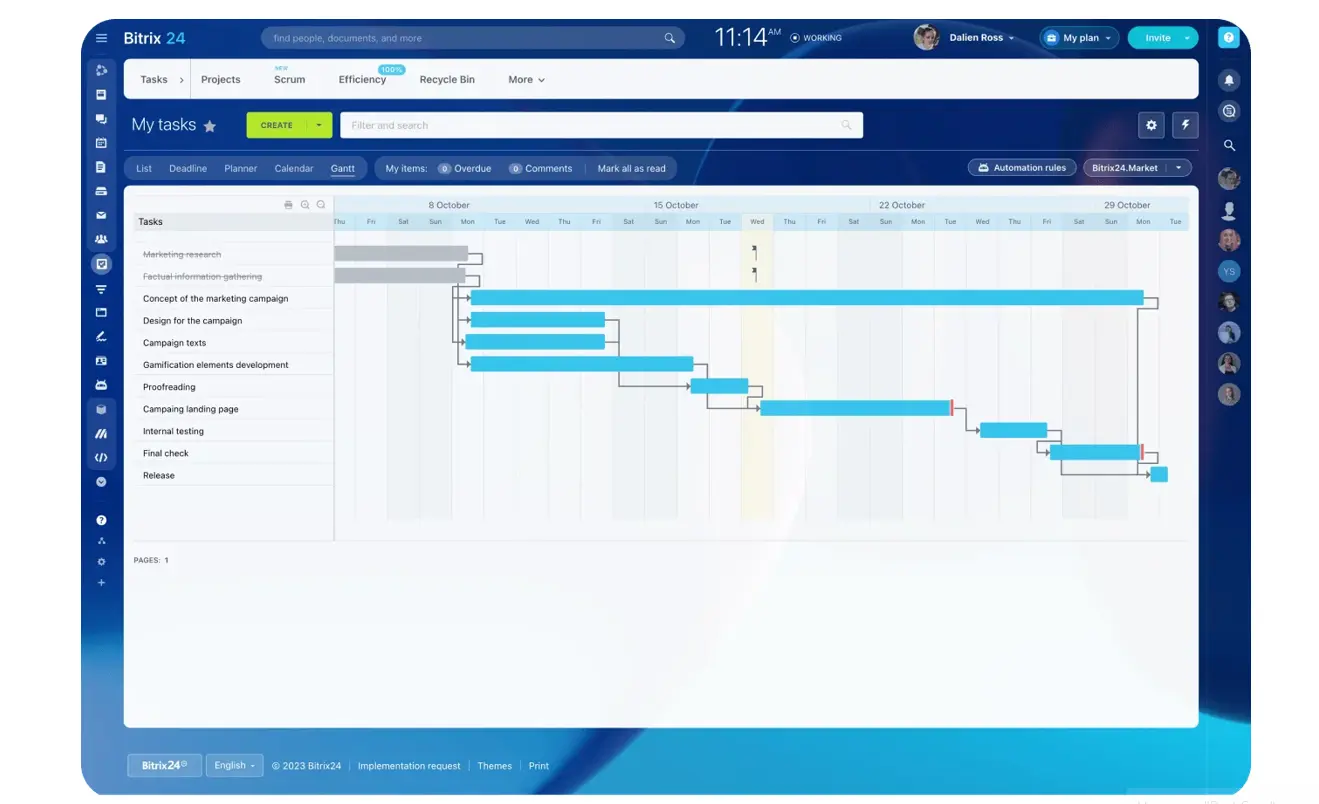
Bitrix24 supports this with Gantt charts and project timelines that visualize these connections and surface delays before they cascade.
3. Maintain a shared workspace for roadmaps and execution
Tool fragmentation is one of the biggest threats to traceability. When roadmaps live in one platform, tasks in another, and communication happens in email, context gets lost with every handoff.
What fragmentation costs:
- Roadmaps become static documents teams rarely revisit
- Sprint tasks lose their connection to strategic initiatives
- Updates are duplicated or missed across systems
- Communication gaps emerge between leadership and delivery teams
What a shared workspace changes:
- Teams see which roadmap initiatives are active and which sprint tasks support them — without switching tools
- Conversations happen where the work exists: comments on tasks, documents attached to projects, roadmap updates discussed inside project workgroups
- Fewer tool switches mean fewer interruptions, clearer workflows, and faster decisions
These are the exact improvements that compound across every sprint cycle. A team that saves 15 minutes per person per day by not switching between tools recovers over 50 hours per month. Time that goes back into actual delivery work.

4. Use task dependencies to preserve workflow logic
Most projects follow a logical sequence. Designers create mockups before developers build interfaces. QA tests after features are complete. When these relationships aren't defined, work starts too early, blockers appear mid-sprint, and timelines slip.
Common dependency types:
- Finish-to-start — Task B begins after Task A completes
- Start-to-start — Tasks begin simultaneously
- Finish-to-finish — Tasks must complete together
When dependencies are mapped, project managers see which activities are critical path, which delays could cascade, and where bottlenecks are forming — early enough to adjust before small issues become delivery problems.
Dependencies also strengthen the traceability chain: initiative → milestone → sprint tasks → task dependencies — showing exactly how individual work contributes to strategic goals.
5. Build dashboards that connect strategy with progress
Even well-structured roadmaps need a reporting layer. Without dashboards, progress questions get answered through manual status meetings and spreadsheet updates that lag behind reality.
What useful dashboards show:
- Roadmap initiatives in progress and their completion percentage
- Milestones completed this quarter vs. planned
- Active sprint tasks linked to each initiative
- Workload distribution across teams
What dashboards make answerable at a glance:
- Are we on track to complete this milestone?
- Which sprint tasks are blocking progress?
- Are any teams overloaded?
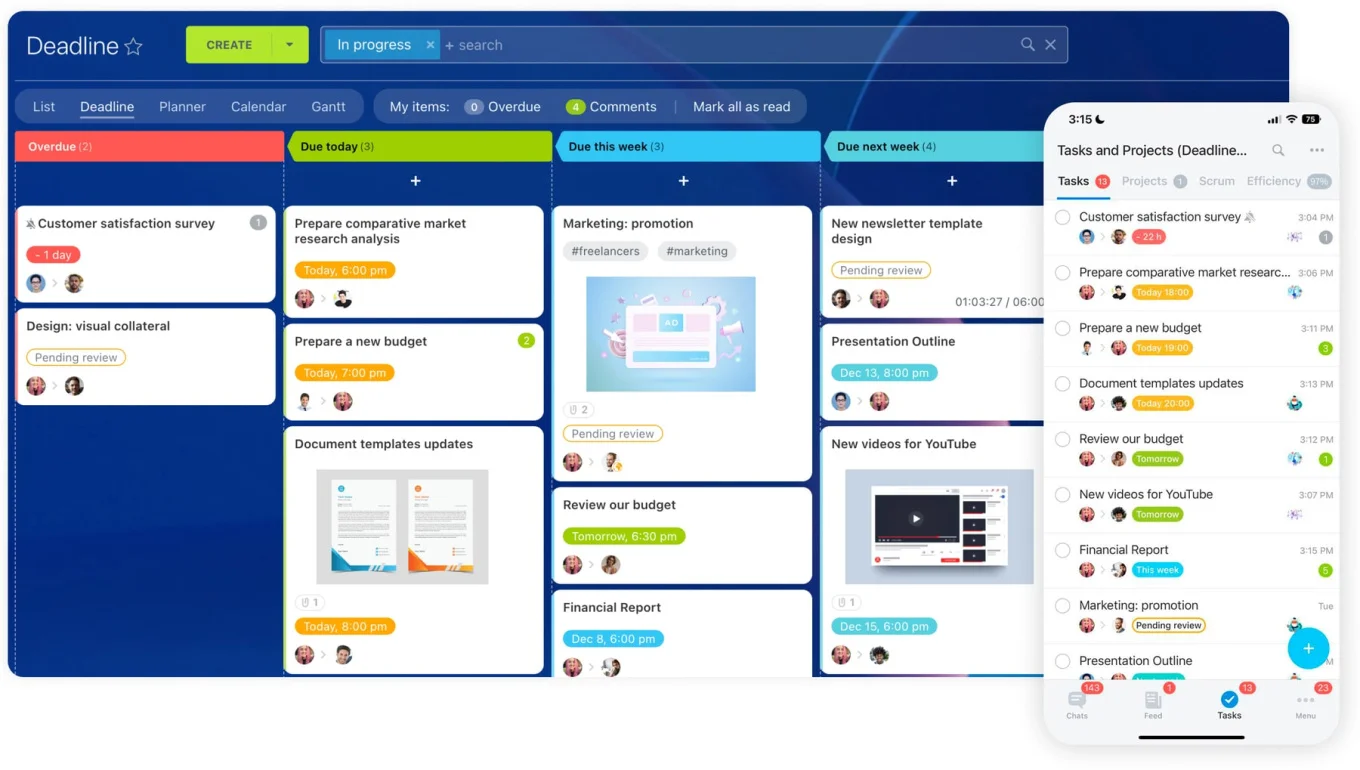
When progress is visible, teams respond faster to challenges and leadership spends less time chasing updates. Bitrix24's analytics and reporting tracks task completion, milestone progress, team workloads, and timelines in real time.
For teams using Kanban boards alongside dashboards, the combination of card-level task visibility and initiative-level progress tracking creates a complete view from daily work to strategic outcomes.
6. Automate the links between planning and execution
As projects grow, maintaining traceability manually becomes unsustainable. Hundreds of tasks, multiple milestones, and parallel sprints create coordination overhead that teams shouldn't carry by hand.
What workflow automation handles:
- Generate sprint tasks when a milestone activates
- Notify teams when deadlines shift
- Trigger follow-up tasks when work is completed
- Update statuses across related workflows
Why this matters for traceability:
Automation clarifies ownership. When tasks are assigned automatically, and updates trigger notifications, team members know exactly when work begins and what they're responsible for. Managers track progress without sending reminders.
Over time, routine coordination happens in the background while teams focus on planning, problem-solving, and delivering work. Sprint cycles become smoother because the handoffs between planning and execution are handled by the system rather than by memory.
Example-in-action: When a "UI Design Complete" task is marked done, automation creates the "Frontend Development" task, assigns it to the right developer, sets the deadline based on the sprint timeline, and notifies the tech lead. No one needs to remember to create the task, look up who's available, or send a message — the workflow handles the handoff.
When traceability practices need adjustment
These six practices assume a baseline of multi-sprint projects with defined roadmap milestones. Some contexts require a different approach:
- Teams running continuous delivery without fixed sprints. If your team deploys multiple times daily and doesn't work in sprint cycles, rigid milestone-to-sprint mapping adds unnecessary overhead. Focus instead on initiative-level tracking with task tagging: every deployed change links to an initiative, but without the sprint container in between.
- Early-stage products where the roadmap changes every two weeks. When product-market fit is still uncertain and priorities shift constantly, investing in a four-level hierarchy creates structure that gets rebuilt before it delivers value. Use a lighter two-level approach (initiative → task) and add the project/sprint layers once the roadmap stabilizes beyond a single quarter.
- Cross-functional programs spanning multiple independent teams. When an initiative requires contributions from engineering, design, marketing, and customer success — each running their own sprint cadence — a single Gantt chart can't capture the full picture. You need program-level coordination above the sprint layer, with each team maintaining its own traceability chain feeding into a shared milestone view.
- Maintenance-heavy teams where most work is reactive. If 70%+ of your sprint capacity goes to bug fixes, support escalations, and infrastructure work, tracing every task to a roadmap initiative creates false precision. Categorize reactive work separately, track it as a capacity allocation, and apply the full traceability framework only to the strategic work that competes for the remaining capacity.
The goal isn’t to apply traceability rigidly, but to preserve the connection between strategy and execution in a way that fits how your team actually works.
In stable, multi-sprint environments, a full hierarchy keeps work aligned and measurable. In more fluid or reactive contexts, simplifying the structure ensures traceability adds clarity rather than overhead.
Traceability as a competitive advantage
Connecting roadmaps and sprints isn’t just a project management practice. It’s what separates teams that deliver real progress from teams that stay busy without moving forward.
When every task connects to a goal, priorities become clearer, progress becomes measurable, and leadership can see exactly how daily work drives long-term outcomes.
Start for free with Bitrix24 and give your team a single workspace where planning and execution stay connected from roadmap to delivery.
Enable strategic alignment
With Bitrix24, create seamless connections from strategy to daily tasks. Equip your team with a unified workspace, automated workflows, and real-time dashboards to boost productivity.
Get Started NowFrequently asked questions
What is traceability in agile project management?
Traceability is the structural connection between strategic goals and daily work. Every sprint task links back to a roadmap initiative through a clear chain: initiative → project → sprint → task. When maintained, teams see how individual work contributes to larger goals, and leadership can track whether sprint activity is actually moving the roadmap forward.
How do I prevent sprint tasks from drifting away from roadmap goals?
Ask one question at every sprint planning session: which roadmap milestone does this sprint support? If a task can't be traced back to an active initiative, it belongs in the backlog or needs explicit justification. A shared workspace where milestones and sprint tasks are visibly connected makes this check natural.
What's the difference between a milestone and a sprint goal?
A milestone is a measurable outcome on the roadmap — such as "release customer analytics dashboard." A sprint goal is the portion of that milestone your team commits to delivering in a single sprint, such as "complete backend data integration." Multiple sprint goals feed into a single milestone over successive sprints.
How many hierarchy levels do I need?
Four levels work for most teams: initiative, project/epic, sprint, and task. Adding sub-tasks helps large teams but risks overhead for smaller ones. Start with four and add depth only where complexity demands it.
How do I get leadership to engage with sprint-level progress?
Don't ask leadership to review sprint boards. Build dashboards that translate sprint activity into milestone progress — the level they care about. When dashboards show which initiatives are on track, which are behind, and what's blocking, leadership gets strategic visibility without task-level detail.
Can traceability work without dedicated project management software?
Technically, yes: spreadsheets can maintain the hierarchy. In practice, manual traceability breaks down as projects scale. When tasks, milestones, dependencies, and communication live in separate tools, the connections degrade with every handoff. Integrated platforms maintain these connections automatically.