From Tech Debt to Holiday Cheer: The B2B Guide to a Cloud-Optimized Tech Stack

With Q4 2025 planning now dictating the year ahead, every business leader—from the nimble startup CEO to the global enterprise executive - is finalizing their strategic wish list. Yet, before any budget is allocated to the glittering promise of AI and the exponential future, a critical liability must be addressed: the unavoidable 'lump of coal' under the digital tree that is technical debt.
For too long, aging systems and quick-fix software have been seen as a necessary evil. But that technical debt is the corporate equivalent of taking out a high-interest loan to patch a leaky roof: the interest payments—the constant maintenance, the crippling slowness, the nagging risk - quickly devour your future budget. Instead of fueling growth, this liability becomes a digital anchor. In the age of autonomous AI, that anchor is an existential risk.
As the visionary Isaac Asimov once theorized about the dangers of static data systems (a theme central to his Foundation series), a business tethered to the past cannot survive the exponential future, and its wisdom will be eclipsed by mere calculation - the same way starlight from a dead galaxy is eventually drowned out by new nebulae.
This sentiment is validated by the findings in Bitrix24's Tech Stack Velocity & Performance Analysis. The study identified three core priorities: retiring technical debt to establish agile, cloud-optimized foundations; investing in intelligent, self-managing systems (like AI-Native ERP and Intelligent Automation) for superior ROI; and accelerating performance through next-gen technologies to enable faster Time-to-Value and sustainable growth.
For 2026, the mandate is clear: businesses must stop pouring budget into reactive maintenance - like perpetually patching fragile legacy systems - and aggressively invest in a cloud foundation designed for breakneck speed and performance. This pivot isn't just about efficiency; it's the prerequisite for unlocking competitive acceleration in the coming AI revolution, ensuring your business is built for tomorrow’s star charts, not perpetually repairing yesterday's fixed orbit.
Your 2026 Tech Wish List: Planting the Mighty Oaks of ROI
If your business is a high-speed starship, you wouldn’t fill the fuel tank with sand. Similarly, this year’s budget is an opportunity to jettison low-value distractions and invest in the twin propulsion systems that guarantee measurable orbital acceleration: Intelligent Automation and the AI-Native central core.
Smart businesses aren't scattering seeds and hoping for the best; they are strategically planting mighty oaks. They are allocating funds to systems that promise immediate, systemic intelligence and measurable return on investment (ROI). The goal isn’t just to be digital; it’s to be intelligent, a fundamental shift that industry experts see as the key to unlocking massive productivity growth across every department, from the command bridge to the landing bay.
What are the Top Two ROI Priorities for Businesses in 2026?
According to recent industry research among business software users, the highest returns will come from systems that automate execution and consolidate intelligence, essentially making your operations self-managing.
Intelligent Automation (IA): The Digital Co-Worker: This is the undisputed champion, selected by 33.16% of businesses. Think of IA as hiring a tireless, 24/7 digital colleague for every person on your team. It’s the antidote to the mountain of soul-crushing, repetitive tasks that burn out small teams and drag down enterprise efficiency. This isn’t simple automation; it’s hyper-automation - solutions that execute complex, multi-step processes automatically, like receiving a customer order, checking inventory, processing the invoice, and updating the CRM, all in a seamless digital relay. The financial evidence is compelling: successful automation programs are often the quickest path to justifying investment, driving labor savings of 20% or more, and freeing up your top talent for strategy.AI-Native ERP: The Central Nervous System: Chosen by 31.55%, this priority signals a demand for an integrated system that acts as the "brain" of the business. For decades, companies relied on siloed tools - one for accounting, one for inventory, one for operations, all yelling at each other across departmental walls. AI-Native ERP is the movement away from that patchwork, creating one central nervous system. This allows the "brain" to analyze real-time data from every corner of the company to predict bottlenecks, optimize pricing, and manage cash flow like a master conductor orchestrating an orchestra. This shift aligns with Gartner's focus on AI-Native development platforms as core strategic trends for the future.
The remaining investments—Data & Analytics (18.18%) and Cloud-Optimized CRM (17.11%) - are the strategic artillery. Analytics investments focus on identifying and reducing high Customer Acquisition Costs (CAC), while optimized CRM applies AI insights directly to sales, acting as a smart compass to boost conversion rates and chart profitable trade routes.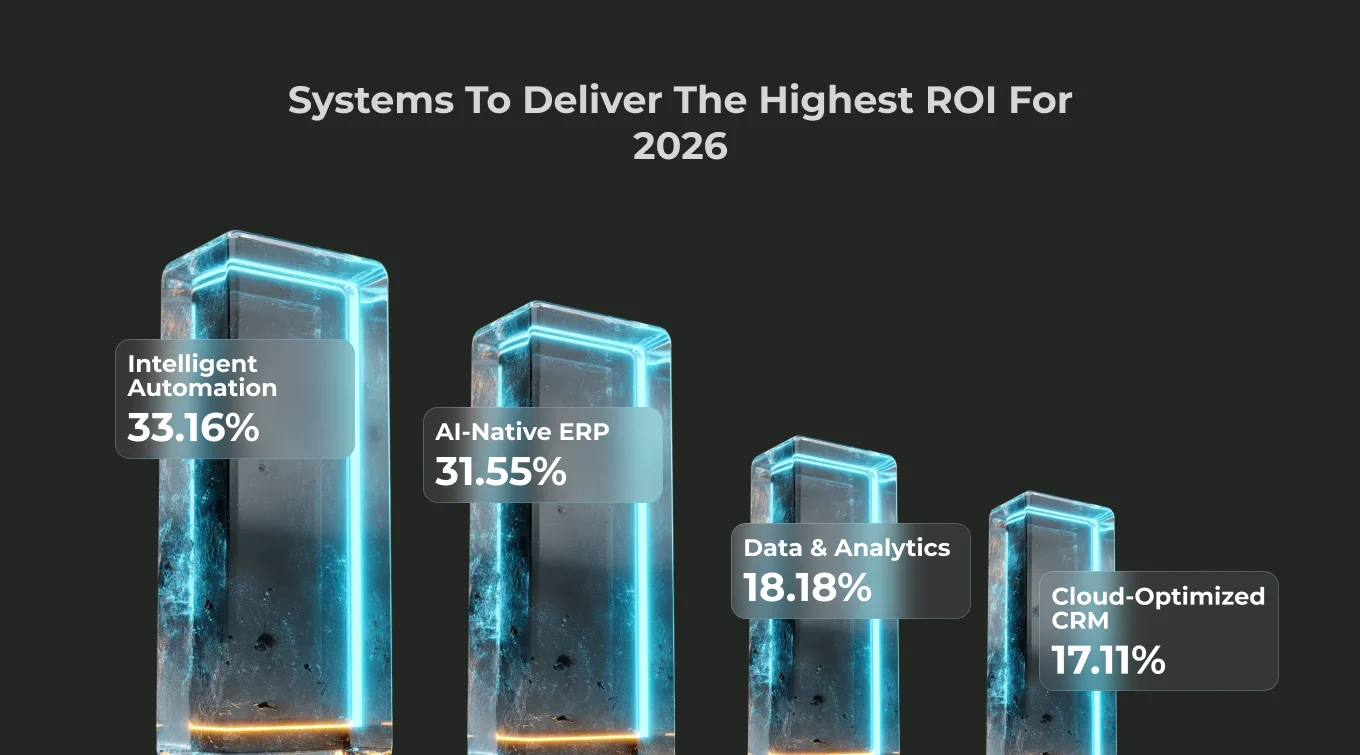
The Acceleration Engine: Why Self-Managing Agents Win
The future of efficiency isn't about better maps; it's about self-driving cars. Autonomous Agents are the market’s overwhelming preference for a reason: they don't just follow a process; they orchestrate outcomes - but they require a modern cloud-optimized road network to function.
If Intelligent Automation is the strategy, the fuel for the engine is one key technology: Autonomous Agents.
What Single Technology Will Most Accelerate a Business’s Tech Stack?
The answer is overwhelmingly Autonomous Agents, selected by a dominant 56.15% of business users. This technology aligns with the Gartner strategic trend of "Multiagent Systems," which analysts predict will dominate the 2026 forecast and drive dynamic workflow orchestration.
Think of traditional automation (Robotic Process Automation, or RPA) as a train on a fixed track - it can only follow the exact route you program. Autonomous Agents are your digital co-pilots. They are not merely following a recipe card; you give them the destination - "Onboard this client in compliance" - and they navigate the traffic, reroute for construction, and adjust the GPS (systems) on the fly. This massive leap is moving automation toward Level 4 autonomy.
The Strategic Catch: Autonomous Agents are the desired future, but they are completely hamstrung by the past. Agents require modern APIs (digital "plugs"), flexible workloads, and distributed data to achieve high-level autonomy. Legacy systems, with their rigid, monolithic architectures and outdated data formats, actively prevent the cross-system coordination necessary for scaled intelligence. They are the fixed train tracks preventing the self-driving car from maneuvering. The overwhelming preference for Autonomous Agents confirms that the market is ready for a transformation that legacy systems actively obstruct, making debt retirement essential. Legacy systems are the gravitational drag preventing liftoff.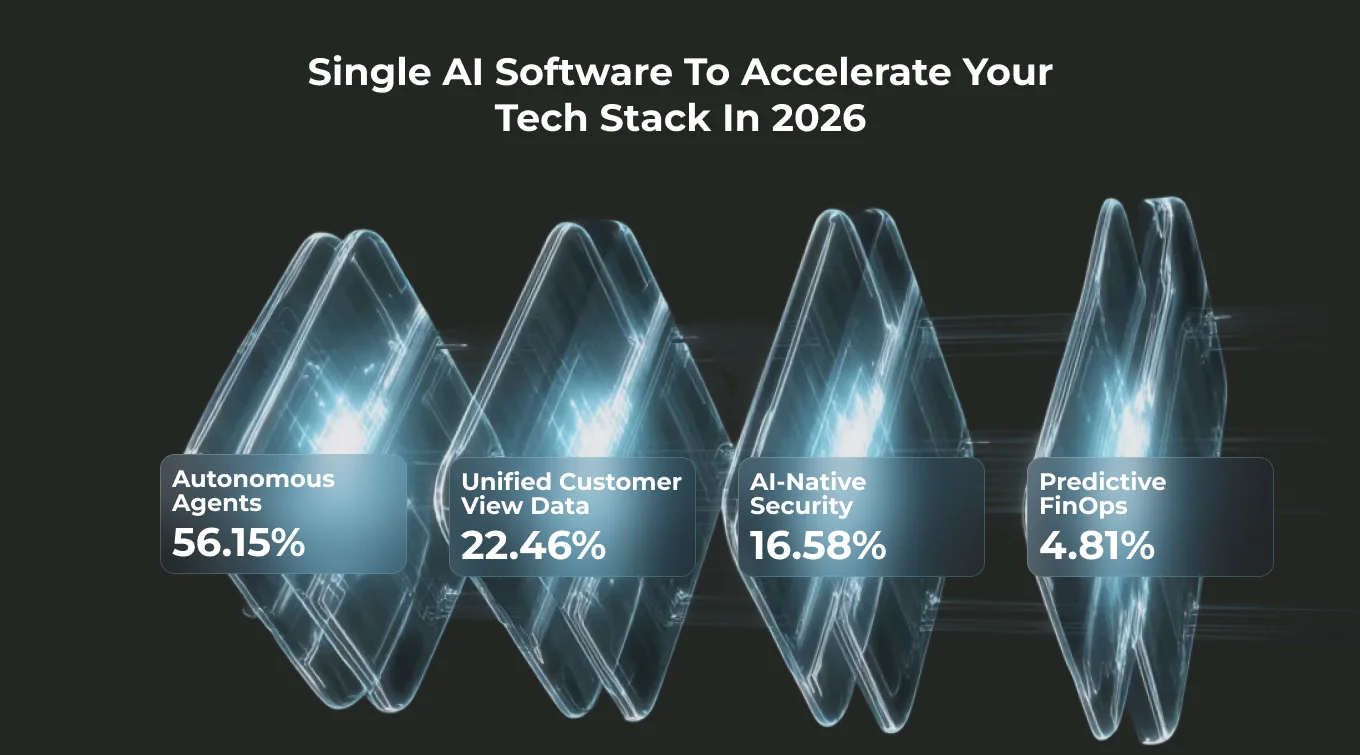
The Ghost of Christmas Past: The Crisis of Tech Debt
Meet the Corporate Rust: the high-interest liability that is quietly siphoning capital and elevating security risk across your entire organization. Ignoring your technical debt is no longer a cost-saving measure - it’s an existential threat to your business stability.
As you budget for 2026, you must quantify the financial and security burden of carrying outdated infrastructure. This is the “lump of coal” that steals your holiday budget and threatens your company's stability.
How are Legacy Systems Crippling Businesses of All Sizes?
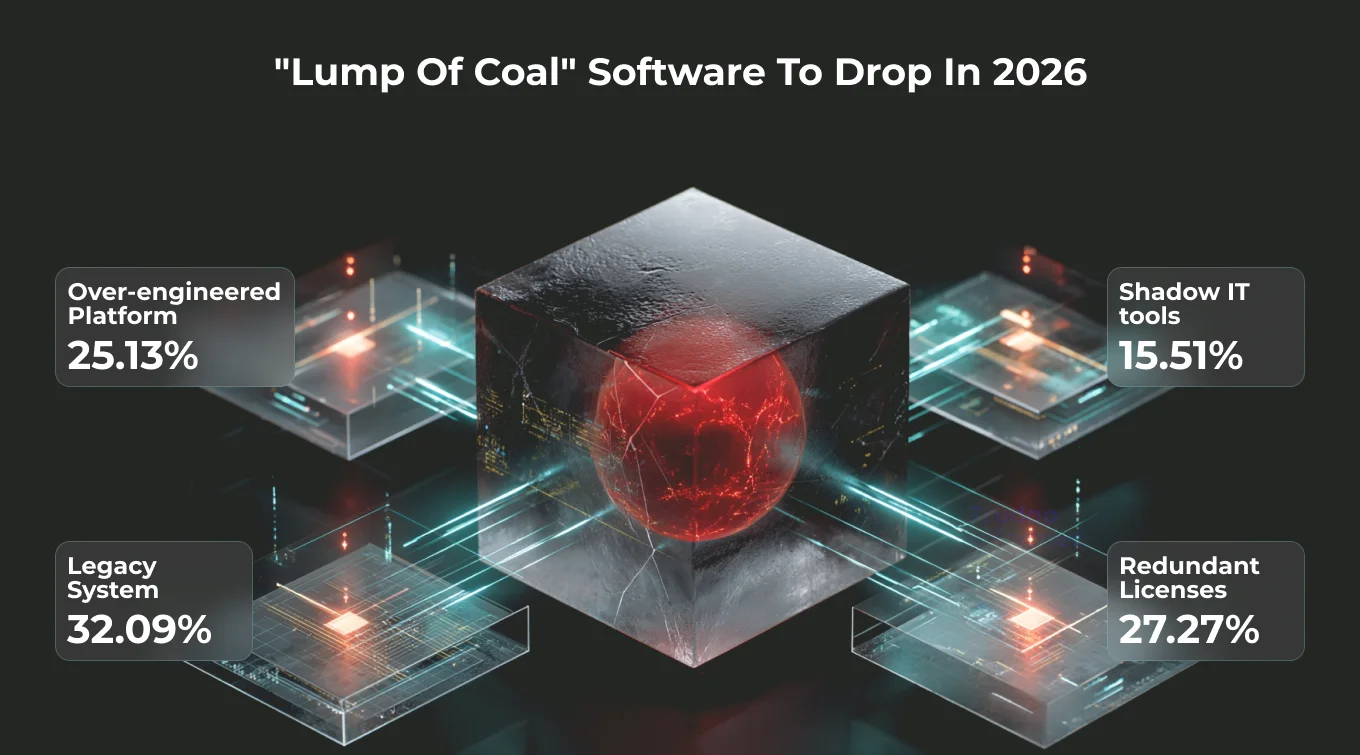
Legacy Systems (defined as high-maintenance, slow, and lacking AI integration) were cited as the primary "software to drop" by 32.09% of users. This debt is not theoretical; it is an existential cost that accrues interest daily.
The Corporate Rust: These systems become financial quicksand. They’re like an old mansion you inherited: the antique charm is gone, but the repairs are bankrupting you. Every minor upgrade requires specialist labor, turning your IT budget into a slush fund for corporate rust. Analyst reports from organizations like Gartner consistently point out that reliance on legacy systems leads to inflated Total Cost of Ownership (TCO) and compliance headaches. Furthermore, companies using legacy systems are significantly more likely to experience compliance failures, exposing leadership to dramatic regulatory penalties.
The Redundant License Drain: The second major debt is Redundant Licenses (27.27%). Many companies try to modernize by layering new cloud tools on top of old systems, creating costly duplication. They end up paying for two systems to do the job of one - the ultimate inefficiency. Analyses of large enterprises show this problem is widespread, draining capital that could be funding innovation. The combined weight of this rust and redundancy threatens to collapse the structure, not unlike a dying, over-burdened space station.
Beyond the Hype: Three More Essential 2026 Tech Trends
While AI gets the spotlight, true competitive advantage is built on the foundational layers of specialized tech. These three trends are what separate a generic AI experiment from a high-precision, compliant, and sustainable intelligent enterprise - where, as Arthur C. Clarke famously stated, any sufficiently advanced technology becomes indistinguishable from magic.
While AI and automation are the engines of the future, they rely on a bedrock of other emerging technologies to function effectively and specifically for your business. For the non-technical leader, these are the three trends to understand:
- Domain-Specific Language Models (DSLMs): The Corporate Barrister.
Generic AI can write a witty email, but it struggles with specialized fields like law, finance, or highly technical product data—where an error could cost millions. DSLMs solve this by acting as your corporate barrister or specialist consultant. They are language models trained or fine-tuned only on a specific industry's data and compliance rules. This hyper-focus delivers much higher accuracy, better compliance, and lower operational costs than trying to use a general-purpose model for a high-stakes task. Think of DSLMs as the specialized navigational computers for trade across regulatory space.
- Digital Twins: The Live-Action Simulation Sandbox.
Imagine having a live, working, virtual replica of your entire supply chain, a new factory floor, or even a critical piece of equipment. That is a Digital Twin. Instead of spending millions on physical prototypes or real-world testing, you can run thousands of scenarios in this simulation sandbox. What happens if a key supplier goes offline? What if demand suddenly triples? The Digital Twin lets you "crash test" your business decisions before they impact real customers or the bottom line, allowing you to optimize performance, predict maintenance issues, and refine products with zero risk.
- Sustainable Tech: Banishing the Energy Vampire.
The amount of energy required to run massive AI systems and data centers has created a new operational concern: the energy vampire. Energy-Efficient Computing is now a core strategic focus, driving companies to adopt more efficient code, use hardware optimized for low power, and actively track their digital carbon footprint. For business leaders, this means two things: significant cost savings on energy bills and reduced regulatory risk, as customers and governments increasingly demand proof of environmentally responsible operations. This is the critical pursuit of clean fusion power for the digital age.
The Velocity Equation: Driving Business Performance with AI
As 2025 closes, the strategic focus is shifting entirely toward maximizing velocity and delivering measurable business outcomes. Forget complex infrastructure debates; the new mandate is about using AI-native systems to shorten the distance between investment and profit.
Time-to-Value (TTV) is the New KPI: Modern cloud systems are designed for rapid deployment. Unlike legacy system overhauls that could take years, AI-native platforms allow businesses to pilot, deploy, and realize returns in months, not fiscal years. This velocity enables a company to respond instantly to market shifts and quickly scale successful pilots, turning successful experiments into massive competitive advantages.
Operational Excellence: The Formula 1 Pit Stop: The core goal is to run a near-perfect operation that is continuously improving. Think of your organization as a Formula 1 team. The AI-Native ERP is the strategy, and the Autonomous Agents are the pit crew, constantly monitoring and adjusting systems in real-time. These systems can self-correct, predict problems before they start, and instantly reallocate resources. This moves the business from reactive management to predictive excellence, maximizing throughput and slashing operational friction.
The Power of Certainty in Decisions: With unified, AI-analyzed data, business leaders move past the gut feeling. AI systems offer predictive forecasts on demand, allowing CFOs to model cash flow under various economic scenarios or CEOs to pivot product lines based on high-certainty demand signals. This ability to make high-stakes, instant decisions with confidence - knowing the data is accurate and auditable - is the ultimate competitive advantage, allowing for course corrections in deep space.
The Annual Software Wish List: A Corporate Comedy
It's late December, and across the corporate landscape, a peculiar ritual unfolds: the annual budget lock-in. Forget cold, hard logic; this is where purchasing decisions often become a mash-up of urgency, fear, and shiny object syndrome. The C-suite gathers, having spent 11 months ignoring the constant wails from the IT department about "legacy systems" and "patching," only to realize they have a looming budget surplus to burn or a critical gap to fill right now. The resulting process is less a strategic allocation and more a frenzy. The conversation usually pivots on two things: What did our biggest competitor just buy? (The Fear of Missing Out, or FOMO purchase) and Which vendor has the best holiday party? (The Relationship Purchase). The biggest winner is often the software that has the snappiest, most viral keynote demo from the last industry conference, leading to the infamous "Magic Quadrant Purchase" - that one platform everyone agrees is "best-in-class," even if nobody on the executive team can explain exactly how it will integrate with the 14 other "best-in-class" solutions already purchased. This rush leads directly to the Redundant License Drain (Part 3), where two or three expensive platforms end up doing the same job, simply because the decision was driven by an end-of-year rush rather than a measured, debt-retiring strategy. The smart leaders, however, approach this like a disciplined investor: they fund the retirement of the high-interest debt first, then make high-ROI, foundational investments that solve a systemic problem, not just the symptom. Your deployment of autonomous systems must include strong security to protect sensitive enterprise data.
Conclusion: Your Three-Step Cloud Migration for Holiday Cheer
The necessity for cloud optimization is undeniable. 2026 is the year businesses must stop perpetually managing debt and start architecting a foundation of resilience and acceleration.
Here is the strategic roadmap for decision-makers:
- Audit and Retire the Debt: Immediately quantify your technical debt, identifying and eliminating every redundant license and high-risk legacy system. Prioritize replacement based on risk: TCO, compliance (as highlighted by Gartner), and incompatibility with modern APIs. Use the capital saved from retiring these "lumps of coal" to fund strategic investment.
- Empower the Agent Incrementally: Invest immediately in Autonomous Agents as your core business accelerator. Achieve integration resilience by adopting an incremental approach, utilizing APIs to introduce AI functionalities gradually. This measured, high-ROI approach sustains internal momentum and validates budget allocations, accelerated by AI modernization tools (as confirmed by industry analysis).
- Govern for Velocity from Day One: Treat Time-to-Value and Operational Excellence as non-negotiable architectural mandates. Build the cloud foundation necessary to support continuous performance optimization and instant decision-making, ensuring your AI acceleration is scalable and defensible in the face of escalating market demand. Velocity is the new currency of competitive space.
By combining aggressive debt retirement with the purposeful integration of foundational, high-velocity technologies, your business can safely deploy the autonomous systems necessary to drive systemic efficiencies—and ensure a future filled with operational holiday cheer, not tech debt regret.
Ready to escape tech debt and accelerate your business with AI-native performance? Take the next step and discover how Bitrix24’s all-in-one, cloud-optimized platform can transform your operations—visit Bitrix24 today and unlock your fastest path to growth.Download the complete guide as a PDF: From Tech Debt to Holiday Cheer: The B2B Guide to a Cloud-Optimized Tech Stack