A CRM Implementation Process in 7 Steps


A CRM implementation succeeds or fails in the order decisions are made.
Teams often start with configuration, then discover the harder questions later: what should the pipeline look like, who owns each stage, which data can be trusted, how handoffs work, and what managers will use to measure adoption.
That sequence creates the familiar problems: rework after launch, low adoption from the people who update deals, and reports nobody believes.
The platform matters, of course. But the rollout process matters more.
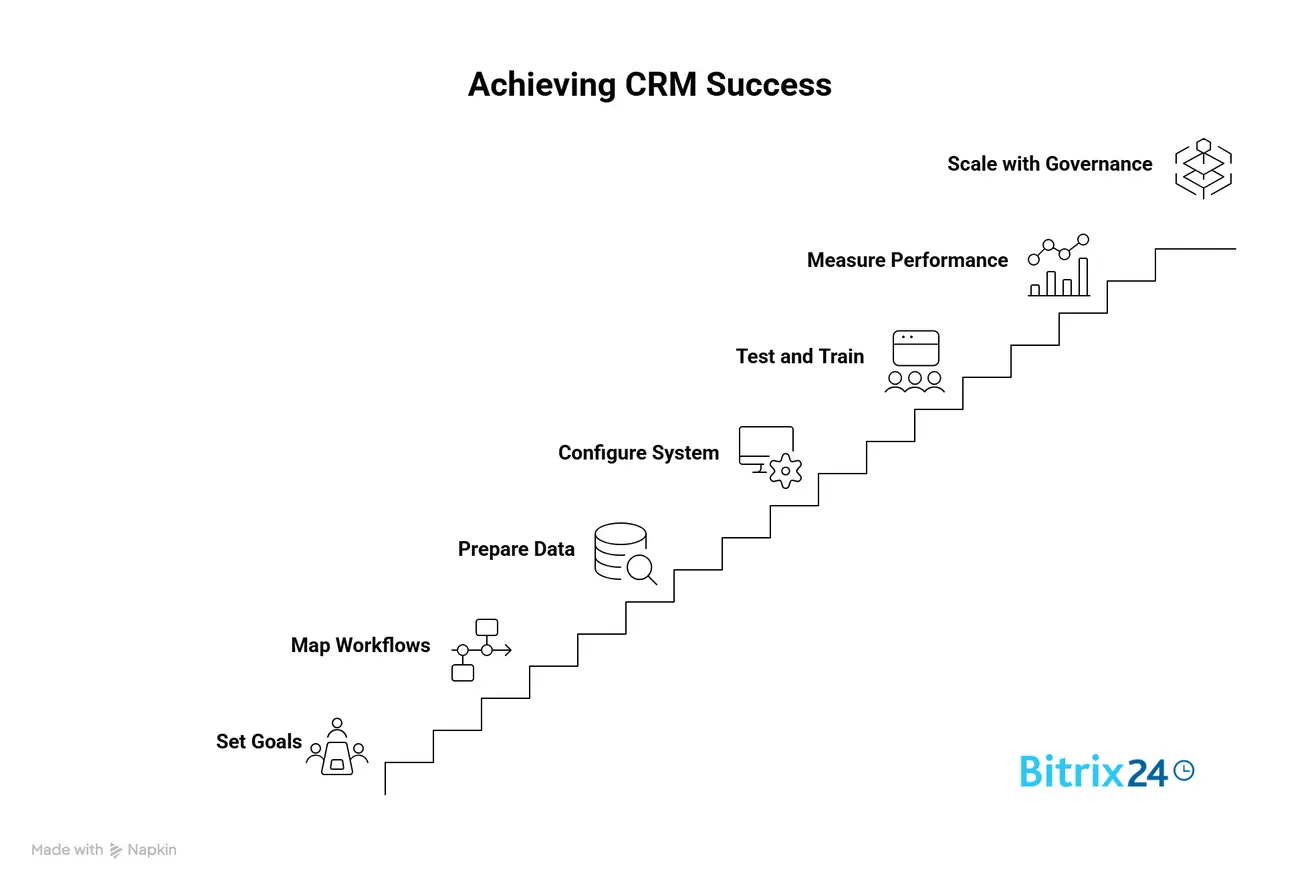
This guide breaks CRM implementation into seven practical steps: setting goals, mapping workflows, preparing data, configuring the system, testing and launching, measuring performance, and scaling with governance.
What CRM implementation actually means
CRM implementation is the full process of planning, configuring, migrating data, testing workflows, training users, and putting the system into daily use. It's not the same as buying a CRM or switching on a few default features.
Buying a CRM gives you software. Operationalizing it means making that software fit how revenue and customer-facing teams actually work, day to day. That usually spans sales, marketing, customer service, operations, and often finance or IT depending on how much you integrate.
A working implementation covers a few core areas:
- Business requirements and process design
- Data cleanup and migration
- System configuration and permissions
- Integrations with surrounding tools
- User testing and role-based training
- Launch support and post-launch improvement
Success comes down to three things: process fit, data quality, and user adoption. If the CRM mirrors the real workflow, holds reliable records, and is easy enough to use every day, it has a chance. Break one of those and the other two wobble fast.
A clean pipeline is worthless if reps won't enter deals, and high login rates mean little if the data behind them is junk.
Why the CRM implementation process breaks down
Most breakdowns aren't dramatic. They're small decisions that pile up. Requirements stay vague. Teams ask for "flexibility" instead of defining rules. Custom fields multiply. Old records get imported because nobody wants to decide what to leave behind.
The research points the same way. David Cockrum, CEO of the consultancy Vantage Point, estimates that people-related challenges drive over 60% of CRM failures and process issues another 30%, leaving only 6 to 10% down to the software itself. The tool is rarely the thing that breaks.
Four ways it goes sideways
- Over-customization: Recreating every legacy edge case instead of improving the process leaves a bloated setup with fragile automations, confusing layouts, and growing admin overhead. A familiar version is the admin who builds 40 custom fields because five reps each wanted their own, and a year later nobody remembers which ones matter.
- Poor data hygiene: Inconsistent lead sources, duplicate contacts, and unclear account ownership make people distrust reports. Once that happens they quietly keep their own spreadsheets, which is usually the start of CRM drift.
- Cross-functional friction: Sales wants speed, marketing wants attribution, service wants complete records, IT wants integrations it can maintain. All reasonable, but without one operating model each team pulls the system in its own direction.
- Rushed timelines: Reporting gets patched after launch instead of designed up front, and automations fire at the wrong time because the field logic was never tested. Managers lose visibility, reps gain admin work, and both complain with good reason.
Quick read: vague requirements create confusion, over-customization creates complexity, poor data creates distrust, and a rushed rollout creates cleanup work that outlasts the implementation itself.
CRM Rollout Toolkit: Timeline, Roles, Risks, Success Metrics
Enter your email address to get a comprehensive, step-by-step guide

Step 1: Set Business goals, scope, and ownership
Start with measurable outcomes, not features. Pick three to five results the business already tracks: better pipeline visibility, faster lead response, cleaner forecast accuracy, stronger renewal tracking, more consistent marketing-to-sales handoff.
"Modernize our CRM" gives you nothing to measure. "Cut average inbound lead response from 18 hours to under 2" does, and so does "95% of open opportunities have a next-step date and a close probability." You can hold a rollout accountable to targets like those.
Define scope before it defines you
Scope should answer four questions:
- Which teams go first
- Which processes are in phase one
- Which geographies or business units are covered
- What's deliberately deferred to a later phase
CRM projects bloat fast. A team starts with sales pipeline management, then adds support ticket visibility, partner channels, contract approvals, and billing sync halfway through. That's how a three-month rollout turns into a nine-month one. It usually starts with someone in a kickoff meeting saying "while we're in here, can we also..."
Assign ownership on day one
At minimum, name three roles:
- An executive sponsor who clears blockers and keeps priorities aligned
- A project owner who drives the decisions, the timeline, and accountability
- Department stakeholders who define requirements and validate the workflows
If nobody owns tradeoffs, the project stalls. If everybody owns everything, it stalls in a different way. One person needs the authority to say no, lock requirements, and keep the rollout from turning into a committee exercise.
|
Area |
What to define |
|---|---|
|
Goals |
3–5 measurable business outcomes tied to operations |
|
Scope |
Teams, processes, locations, and phase boundaries |
|
Ownership |
Sponsor, project lead, and stakeholder roles |
|
Success criteria |
What "good" looks like 30, 60, and 90 days after launch |
Step 2: Map current workflows and design the future-state process
Before touching configuration, you need two pictures: how work moves today, and how you want it to move once the CRM is live.
Map what happens today
Document the operational path: how leads enter, how they're qualified, how opportunities get created, how accounts are updated, how handoffs happen, how follow-ups are tracked.
In practice, this takes a few working sessions with the people who do the work, not a month of documentation.
You don't need a process encyclopedia, just enough to see where things break. Maybe inbound demo requests land in a shared inbox and sit half a day before someone assigns them by hand. Maybe two account executives build opportunity stages differently, so pipeline reports never reconcile.
Mapping the current state tends to surface three things:
- Bottlenecks that slow response or movement
- Duplicate steps that create admin work
- Gaps where ownership or rules are unclear
Design the future state
In the Harvard Business Review study "The Short Life of Online Sales Leads," firms that contacted a lead within an hour were about seven times more likely to qualify it than those that waited even 60 minutes, yet the average response time across audited companies ran to 42 hours.
If you want marketing-qualified leads contacted inside one business hour, define who owns the record, what timestamp starts the SLA, what status change counts as a response, and what escalation happens when the window is missed.
Skip those details and the automation will look fine, while behaving badly.
End with one agreed workflow per major process, with entry criteria, exit criteria, owners, and the data required at each point.

Step 3: Audit, clean, and prepare CRM data for migration
Most teams underestimate this step. Then launch arrives and everyone realizes the shiny new CRM is full of old junk (just with better branding). Data work is usually the longest part of a rollout, and it's almost always done by whoever knows the source systems best, which is rarely the project lead.
Inventory the sources
List everything: spreadsheets, legacy CRM exports, sales inboxes, marketing automation, support tools, maybe ERP or billing if customer records live there.
For each source, note who owns it, how current it is, and whether it should migrate at all.
Clean aggressively
Remove duplicates. Standardize company names, phone formats, owner names, countries, lifecycle statuses, and date formats. Archive stale records that no longer help the business. Incomplete data isn't automatically useless, but bad data shouldn't get a free ride into the new system.
A simple test helps here: if a record wouldn't be actionable, reportable, or relevant in the next 12 months, question whether it belongs in the phase-one migration.
Map fields and stage the migration
Every source field needs a destination, transformation logic if required, and a decision for anything unmapped. This is also the moment to set governance standards: required fields, naming conventions, ownership rules, and duplicate handling.
Not everything moves at once. A staged order works for most teams:
- Active accounts, contacts, and open opportunities
- Recent lead and activity history needed for current work
- Selective historical records for reporting or service context
Migrating everything because "we might need it someday" is a classic mistake. It clutters the system, drags out testing, and buries the records people actually use.
Step 4: Configure the CRM, integrations, and core automations
Now build around the process decisions you already made. Configure pipelines, record types, required fields, page layouts, permissions, dashboards, and reporting logic to support the workflow, not to make users guess what comes next.
Good configuration feels boring in the best way: Reps know which fields matter. Managers see pipeline health at a glance. Marketing can trace lead progression. Service gets the customer context it needs without asking around.
Get permissions right
Permissions deserve more attention than they usually get. Different roles need different visibility and edit rights. If everyone can change core fields freely, data quality slips. If restrictions are too tight, people build side workarounds in spreadsheets.
Aim for controlled access that doesn't make the CRM irritating to use.
Sequence integrations by dependency
Start with the systems that touch daily work and data accuracy. Bitrix24's integrations and marketplace cover most of these connections. Common priorities, in order:
- Email and calendar sync for activity visibility
- Marketing automation for lead capture and lifecycle updates
- Support platform for account context and service history
- ERP or billing tools where order, invoice, or renewal data matters
Deeper finance and ERP work can wait until the core process is stable. Trying to wire up billing sync before sales stages are agreed is how integration projects stall.
Keep automation tight
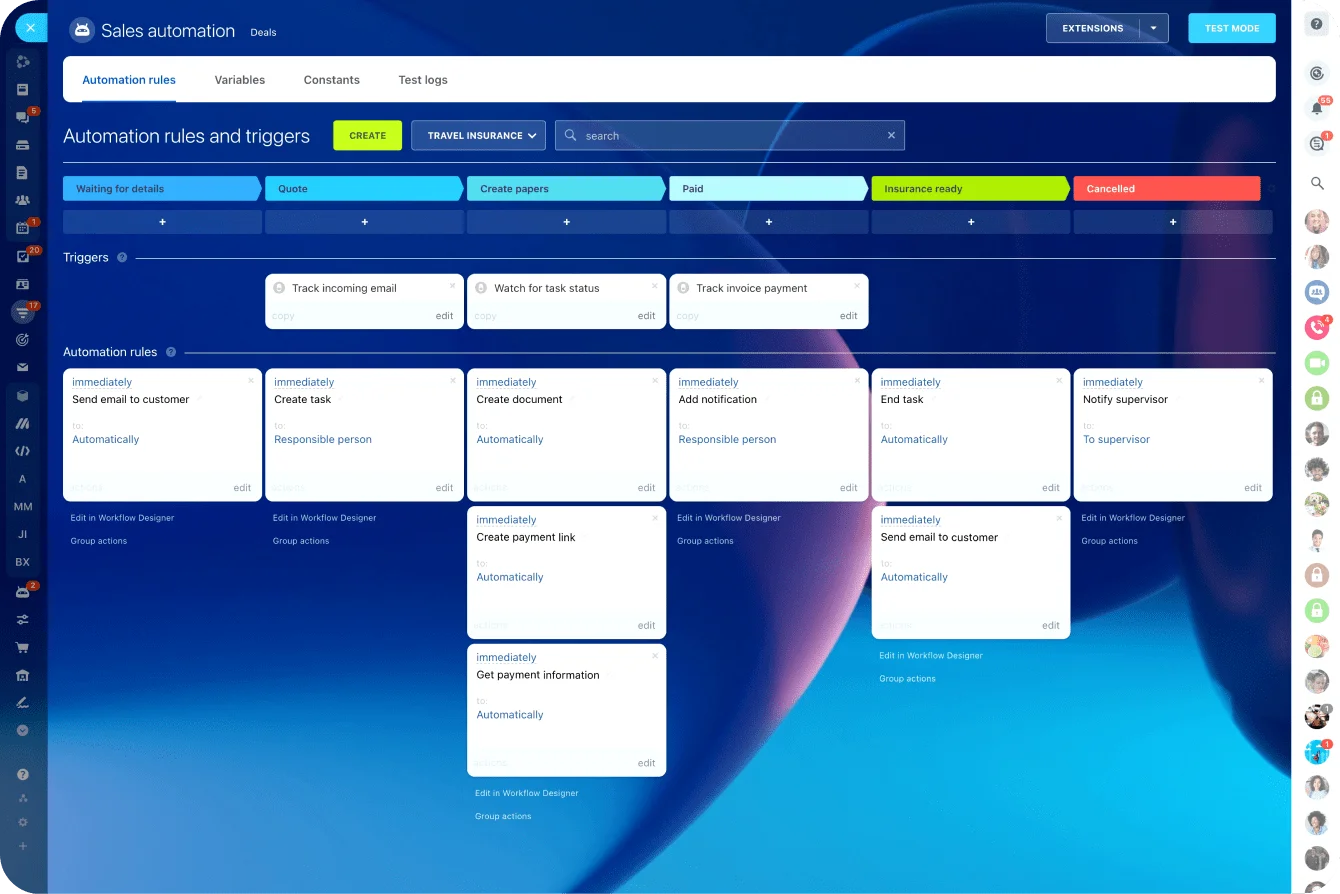
Early rollouts often break because teams automate too much, too soon. Start with high-value actions: lead routing, reminders, task creation, owner assignment, SLA alerts, and basic status updates. Bitrix24's CRM workflow automation handles these without much setup.
If you're tempted to build a complicated workflow for a rare exception path, a word of advice: don't! Handle edge cases manually until the core process is stable.
Fancy automation is attractive. Reliable automation is better.
Step 5: Test, train, launch, and stabilize adoption
Testing should reflect real work, not just admin checks. Use role-based scenarios for reps, managers, marketers, and service users. Ask each group to do what they actually do: convert a lead, update an opportunity, reassign an account, log a customer issue, review a dashboard, trigger a handoff.
That surfaces practical problems fast. A manager notices a missing forecast field. A rep hits a required field that makes no sense at an early stage. Marketing finds lead statuses that don't sync cleanly. Far better to catch that in testing than after launch with a few dozen irritated users.
Train by role, not by menu
Don't give everyone the same one-hour walkthrough and call it enablement. Teach daily workflows, data entry standards, ownership rules, and reporting expectations for what each group actually does.
Show people how the CRM helps them move work faster, not how the menus are arranged. Reps care that clean next-step tracking gets managers to clear blockers, and service teams care that full account history stops customers having to repeat themselves. Relevance is what drives adoption.
Launch in phases and watch the first 60 days
Roll out by team, region, or process if you can. A controlled rollout reduces chaos and gives the project team room to fix issues without destabilizing the whole business.
The first 30 to 60 days matter most. Watch for adoption blockers like confusing layouts, duplicate notifications, unclear field definitions, or reports that don't match reality.
Short stabilization checklist:
- Track login and usage patterns by role
- Review support tickets and user feedback weekly
- Fix high-friction issues fast
- Reinforce data standards in manager reviews
- Retire old spreadsheets and side systems deliberately
That last point is where a lot of rollouts quietly fail. If a manager keeps running the Monday pipeline meeting off a personal spreadsheet, the team learns the CRM is optional, and within a quarter you're back to two systems of record.
Step 6: Measure CRM adoption and performance after launch
A CRM launch isn’t finished when users get access. The next job is to check whether the system is being used properly and whether it’s producing better operational signals.
Start by measuring behavior, not just logins. A user can log in every day and still keep the real pipeline in a spreadsheet. Track adoption by role, pipeline hygiene, SLA compliance, lead follow-up consistency, dashboard usage, and required-field completion.
Then compare those signals with business outcomes:
- Are leads being followed up faster?
- Are opportunities moving through stages more consistently?
- Are managers using CRM dashboards in review meetings?
- Has forecast accuracy improved?
- Are support, renewal, or handoff records easier to trust?
Bitrix24’s analytics and reporting tools can help track both workflow activity and business performance, provided the fields behind those reports stay clean.
The warning sign is mismatch. If usage is high but data quality is poor, the rollout isn’t healthy. If dashboards look clean but frontline users still manage deals somewhere else, the CRM hasn’t become the system of record. You need both adoption and reliable data before scaling further.
Step 7: Scale the CRM with governance
Once the first release is stable, scale carefully. Add complexity in layers rather than opening the door to every new field, workflow, integration, or automation request.
Start with the repeat offenders that usually weaken a CRM after launch:
- Over-customization, where fields, objects, and automations pile up until admin work takes over
- Training that shows people where to click but not what good process looks like
- Governance gaps, where nobody owns field changes, reporting rules, or data standards
- A missing change plan, so teams hear the CRM is live with no support, reinforcement, or clear expectations
Set rules for how the CRM changes
A reliable CRM needs rules for how it changes. Decide who can request changes, who approves them, how configuration updates are tested, when releases happen, and how documentation stays current.
In Bitrix24, that governance should cover pipelines, custom fields, permissions, automation rules, dashboards, integrations, and reports. Without those rules, each team starts reshaping the CRM around its own preferences, and the system slowly drifts away from the operating model you built.
Scale the CRM once the core process works. Stabilize sales and customer workflows first, then extend dashboards, integrations, and automation based on validated needs. A system that scales keeps its process rules clear as more teams, markets, and use cases come online. Feature count has little to do with it.
FAQ
When should data migration happen?
After process design and field mapping are defined, but before final user acceptance testing. Test with realistic migrated data, not toy examples, so you catch the problems your real records will cause.
How large should the implementation team be?
Usually a lean core team works best: one executive sponsor, one project owner, one admin or systems lead, and key stakeholders from each major function. Pull in specialists as needed instead of building a large standing committee.
Do we need a sandbox?
Yes, if the platform supports it and the rollout has any meaningful complexity. Testing configuration, integrations, and automations in production is asking for trouble.
What order should integrations happen in?
Start with systems that directly affect daily workflow and data accuracy, such as email, calendar, marketing automation, and support tools. Add deeper finance or ERP integrations once the core process is stable.
Should we launch everything at once?
Usually no. A phased rollout is safer unless the business is very small and the process is simple. Big-bang launches look efficient on paper and tend to create messy cleanup afterward.
What if teams insist on keeping old spreadsheets?
That usually signals a trust or usability problem. Fix the reporting, workflow, or data issue behind the behavior first. Then set a firm cutoff for legacy trackers so the CRM becomes the actual system of record.
Build a CRM your team actually uses
Bitrix24 brings CRM, automation, reports, tasks, and communication together to streamline rollout and keep customer data trusted.
Get Started NowBuild a CRM your team actually uses
CRM implementation succeeds when the process is clear before the system goes live. Set the goals, clean the data, define ownership, test real workflows, and train people on the work they’ll do every day.
Bitrix24 gives you the CRM, automation, reporting, task management, and communication tools to bring that process into one place.
Ready to build a CRM your team can trust?
Start with Bitrix24 and turn your rollout plan into a system people use from day one.